
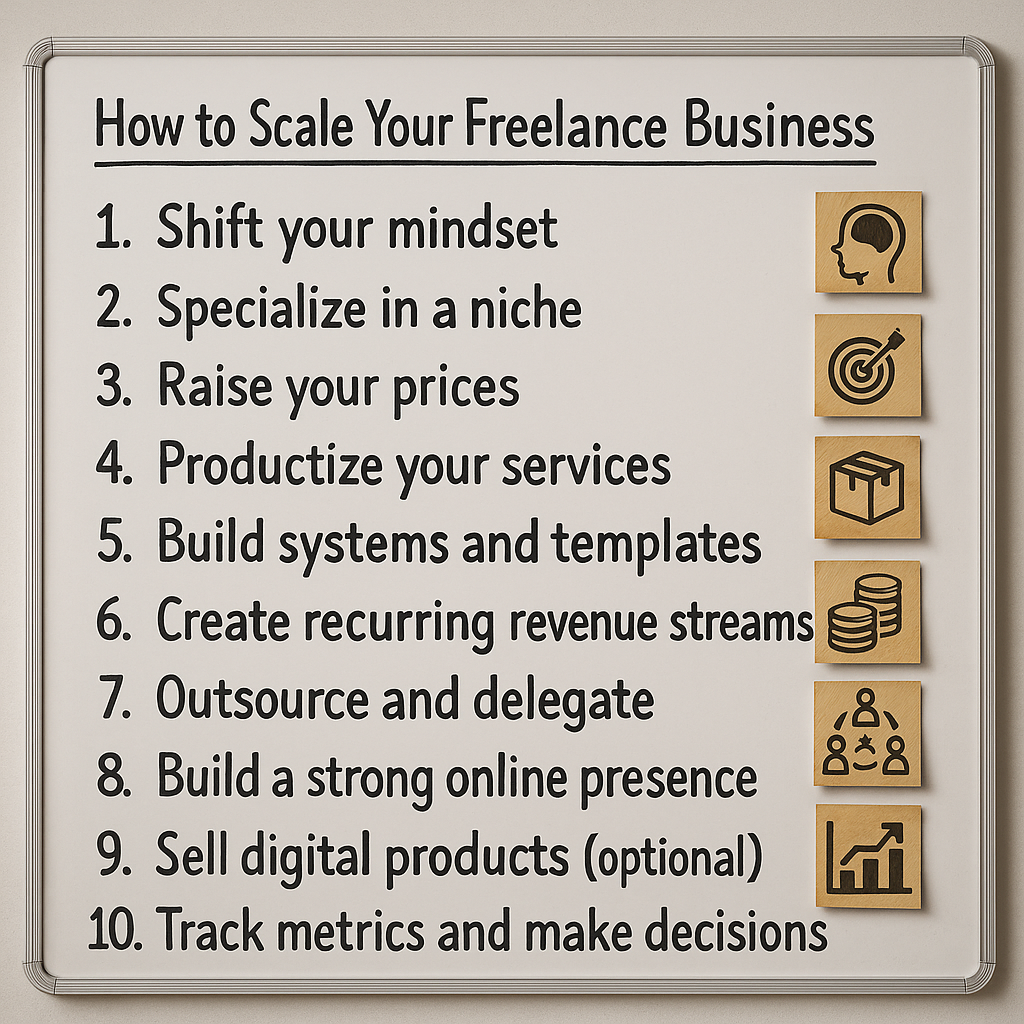
Freelancing gives you freedom, but it can also trap you in a cycle: more clients, more hours, more pressure. Eventually, you hit a ceiling — there are only so many hours in a day.
That’s where scaling comes in.
Scaling means growing your freelance business beyond trading time for money. It’s about building smarter systems, offering more value, and increasing income without working 24/7.
This article will show you how to scale your freelance business step by step, so you can earn more while regaining time and energy.
1. Shift Your Mindset: From Freelancer to Business Owner
The first step is seeing yourself not just as a service provider — but as the CEO of your freelance business.
This means:
- Thinking in systems, not tasks
- Prioritizing long-term strategy
- Building repeatable workflows
- Investing in tools and talent
- Protecting your time like a resource
You’re not scaling to get busier — you’re scaling to get better.
2. Specialize in a Niche
Generalists compete on price. Specialists get paid more — and faster.
Benefits of niching down:
- Clearer messaging
- Easier to attract ideal clients
- Higher perceived value
- Faster project delivery
- Stronger portfolio impact
Example:
Instead of “freelance writer,” position yourself as “email copywriter for SaaS startups.”
3. Raise Your Prices Strategically
As demand increases and your results improve, raise your rates to reflect your value.
Don’t double prices overnight. Instead:
- Increase your minimum project fee
- Package services with fixed pricing
- Justify increases with case studies or testimonials
- Test new rates with new clients
Higher rates = fewer clients, more income, less stress.
4. Productize Your Services
Instead of custom quotes for every client, offer predefined packages.
Examples:
- “3 blog posts/month for $800”
- “Landing page design for $1,200”
- “Logo + brand style guide for $900”
Clients love clarity. Productized offers make buying — and scaling — easier.
5. Build Repeatable Systems and Templates
If you do something more than twice, systemize it.
Create templates for:
- Proposals
- Contracts
- Onboarding emails
- Project timelines
- Reports and handoffs
Tools like Notion, Trello, ClickUp, and Zapier help automate repetitive work and save hours every week.
6. Create Recurring Revenue Streams
One-off projects require constant marketing. Recurring offers bring predictability and scale.
Ideas:
- Monthly retainer packages
- Ongoing social media/content support
- Maintenance plans for websites
- Email newsletter management
- Coaching or consulting calls
Aim for at least 30–50% of your income to be recurring.
7. Outsource and Delegate
You don’t have to do everything.
Outsource:
- Admin tasks (email, invoicing)
- Design or editing support
- Client management or research
- Anything that drains your energy or limits your output
Start with one small task. As your income grows, build a freelance team you trust.
8. Build a Strong Online Presence
A scalable brand brings clients to you — not the other way around.
Focus on:
- A professional website
- SEO and blog content
- Thought leadership on LinkedIn
- Testimonials and case studies
- Consistent branding across platforms
Your brand = your business multiplier.
9. Sell Digital Products (Optional)
If you’re ready to step into passive income, consider:
- E-books or guides
- Templates and swipe files
- Mini-courses or workshops
- Notion or Canva templates
- Licenseable assets (icons, music, photos)
Start simple. Use Gumroad, Payhip, or Lemon Squeezy to launch quickly.
10. Track Metrics and Make Decisions with Data
Don’t scale on instinct — scale with insight.
Track:
- Monthly revenue and profit
- Project completion time
- Lead sources and conversion rates
- Hours worked per project
- Client satisfaction
Use this data to refine offers, pricing, and time allocation.
Final Thoughts: Scale with Intention, Not Just Ambition
Scaling isn’t about doing more — it’s about doing better. It’s about freeing yourself from burnout, raising your standards, and designing a freelance business that works for your life.
Start by identifying what’s working — then multiply it.
You’re not just building income. You’re building independence.
Scale smart, scale slow, and scale on your terms.